Jamie Tennant interviewed by Debra Martens
Jamie Tennant is the author of The Captain of Kinnoull Hill (Palimpsest Press, 2016) and River, Diverted (Palimpsest Press, 2022). Writer, broadcaster, freelance writer and editor, he hosts the interview podcast, GET LIT. He lived in Japan in the late 1990s and has returned to visit many times since.

Martens: I understand that you visited friends in Japan before returning, after your father’s death, to work there. For how long were you in Japan, and also, Perth, Scotland? Which trip came first? Anywhere else? What prompted you to go?
Tennant: My family never travelled. In high school, I was lucky enough to end up on a theatre trip to London, UK. Then it was university and student-level poverty for me. After graduation, I landed a job touring across North America as the roadie for a ska band (King Apparatus, what up?).
It was the mid-90s when some sweet friends fronted me the cost of a ticket to Japan. I travelled there twice before living there, roughly 1996 to 1999. I’ve been back to visit 10 times since which, writing it down, I realize is bananas.
Scotland happened shortly after my first trip to Japan. After my father passed it felt more important to go and see where he grew up. Very glad I did!
Martens: During your stay in Japan you worked in a bar, J.J. International, and tutored English. What did you do in Scotland for survival? What did you do before you left Canada? And now what pays the bills?

Tennant: I never lived in Perth but sometimes it feels as though I did. My father was born and raised there, before coming across on the S.S. Sylvania in the mid-50s. Having some family there, I was able to see a bit of “real” Scotland, not just the “shortbread tins.” At least three of my trips were for research, filled with walking, note-taking, and photography.
Today, I’m the Program Director at 93.3 CFMU FM, the station at McMaster University. I have been a freelance writer for decades, though, and have also added freelance editing to my resume. Writing books doesn’t pay too many bills, but it helps!
Martens: River, Diverted takes place in Nagano, in the mountainous region of Japan, and The Captain of Kinnoull Hill takes place mostly on a hilltop in Scotland. In both novels the characters are most at peace on top of a hill. What is the attraction of a hill for you? Do you have favourite spots?
Tennant: I always have to see the view! Whether that’s going up the Scott Monument or Petrin Tower in Prague, I am drawn to get as high up as I can. I’ve been fascinated with Kinnoull Hill since I was a child and standing on top of it, looking out across Perthshire, made a very big impression on me. Kinnoull Hill and the sakon inari (from River) are two of my favourite places in the world.

This question prompted me to make a connection I’ve never made before! When I was a pre-teen, I was fascinated by a hill in Hamilton. It’s difficult to explain it, but it was some kind of stone barn that collapsed upon itself and was subsumed by the landscape, eventually forming a sizeable dirt hill with grass and trees atop it. I used to go there and thought of it as “my spot.” I dubbed it Solsbury Hill (hey, I was a Peter Gabriel fan). I’d forgotten how far back my connection to the hills started.
As to why I wrote about Kinnoull Hill and Asahi-yama … both places had very different meanings for me, but when I was working on the abandoned monster of a novel that eventually become Captain and River, I had both storylines happening at once. I realized two of my favourite towns had hills that I loved, and I couldn’t resist the symmetry….
Martens: Both hills have a ruin, the folly in The Captain and the abandoned temple in River. Of all the towers in all the parks and castles in the UK, why did you choose a folly? What is the metaphor at play here? And of all the temples in Japan, why an abandoned one?
Tennant: Oh, great (and difficult) question. I have to be straight about it and say it’s largely coincidence. The two places I chose just happened to have “ruins” on them. Neither, however, are actually ruins; one’s fake, merely built to look like ruins, while the other is actually attended to, swept and kept neat, though at first glance the place seems abandoned.
I’m fascinated at how we can subconsciously weave themes and motifs into our work. It’s accidental intention. I’ve had readers ask me about a motif where my honest response was “I didn’t notice I’d done that.” The ruins are like that. However…if you’re lucky enough to see it while you’re doing it, you can use it.

In Captain, we have a fake castle ruin. It is however, a real structure. It is both real and not-real. This is where Dennis and Eddie exist in their lives. They are trying to sort out what parts of themselves are real. Eddie is not a human, but he’s more human than Dennis in some ways. Dennis is an awful person, but much of it is a construct, a persona. Both real and not-real.
In River, it’s more about the place being forgotten than being abandoned. It appears forgotten, but we know it isn’t because of the steps that lead to it and the care someone takes to tidy the shrine. This mirrors other themes, especially River’s past, which is forgotten and, as we find out, not forgotten.
One fun thing: the section where River gets lost trying to find the shrine? This really happened to me. I thought I’d forgotten the way. Turns out that the way had merely changed slightly. My memory had been correct, but I hadn’t trusted it. The whole thing fit my book’s themes so neatly it was spooky. Sometimes writing is strange.
Martens: I agree with River’s respectful approach to trying to understand the culture that she finds herself in, and it is clear from the knowledge you display in the book, from language to places to customs, that you do, too. But I’m curious to know when or where you came across the kappa, the Japanese river monster that is featured in the story-within-the-story, the tale of Kenichi and the Kappa, the book that launches River’s return to Japan?
Tennant: In the abandoned novel that became both Captain and River, I wanted two very different stories that were symmetrical in ways that suggested they were happening in a shared universe. That was one of the things that didn’t work, but I always liked the idea. I’d been inspired to use non-human characters by Haruki Murakami (specifically Kafka on the Shore at the time). I don’t recall which creature came to mind first. However, I learned about the kappa in its modern-day form, in other words, the cute, cartoon form. There’s a restaurant chain called Kappa Sushi, and there’s a statue of a kappa on the main road in Nagano (he’s in my author picture with me). I started there and learned the folklore around the kappa. The more I learned, the more I knew this was the right creature to write about, especially given all the water imagery in the book. Fun fact about that: River’s name was unintentional. I didn’t give her that name to be thematic; I simply came up with a random name (Helen Delaney), looked up it’s meaning, and found the perfect pen name for her. It was accidental, sort of.
Martens: Let’s talk about the strangely appealing monsters in both books. First, these are not run-of-the-mill monsters, as they do not stick to their folkloric depictions. Instead, they talk, they argue, they give unwelcome advice: Dennis talks to the Redcap, and River talks to the kappa. The Redcap comes off as real, a living creature, but River’s monster is very much River’s, a creature projected from her brain. Or not. It doesn’t matter whether the monsters are real, as their role is to guide the humans towards redemption, or self-realization, towards a place from which they can make amends to those they have hurt. Am I on the right track so far?
Tennant: Absolutely! Eddie is 100% real, a flesh-and-blood creature. Soba is a different matter. Though I have my own opinion on it, I wanted to leave Soba’s existence (or lack thereof) up to the reader. You’re absolutely right, though, in that it really doesn’t matter in terms of what the character provides in the book.
Martens: So you have this woman, River, who keeps a horrible memory at bay by writing bad horror movies and who chooses emotionless lovers. Her buried memory, her fear, has made her selfish and unkind to others. In The Captain, you have this man, Dennis, who is so monstrously selfish (or as the powrie says, a souless ghoul) that his best and for a time only friend is itself a monster who is more human than he is. Redemption for such people is huge. Difficult. And would be in any setting. But my question is this: why these monsters? Why Scotland, why Japan – why do these characters travel so far to confront their monsters?
Tennant: Another good and difficult question. I wish I had a better answer! I’d argue that it has nothing to do with the locations themselves and everything to do with my relationship to these places. Travel has always been a monumental, moving experience for me. I tend towards introspection when I travel. There’s a bit of that; the idea that when we’re away from our usual rituals and our usual habitat, we might see certain things more clearly. Both these places hold a lot of emotional resonance for me, and I wanted to tap into that. For Dennis, it was about putting him somewhere completely different, in a ridiculous predicament that he wouldn’t have fallen into at home. For River, it was about having her return to her past, which just happens to be so far away. Travelling into our past can be a monumental journey, and it’s mirrored by her own literal journey east.
Let me add that another part is simply this: I love these places, and I’ve always wanted to write about them!
Martens: Expats travelling to escape their problems only to find that they are the problem – a bit of a stereotype. Were you aware of this as you created the monsters and the difficult situations that River, and Dennis, find themselves in, stories that set them apart from any such stereotype?
Tennant: Yes and no. My experience with expats from various countries, at least some of the ones I met in Japan, suggests that many of them do not learn that they are the problem. I remember thinking that I met so many interesting, strange people, but some of them were clearly problematic folks with difficult personalities. If they were unhappy at home, I thought, it’s because people at home were sick of their bullshit. They expected to fit in better abroad. Some did, and some didn’t. Some grew, and some didn’t. Some returned home…some didn’t.
Dennis didn’t think he had any problems. Dennis believed himself to be the master of every situation! So right there, I think he evades part of the stereotype. The “magic boarding pass” diverts him (hah!) from his normal life. Given his preference he never would have left Chicago. I was more concerned with evading another stereotype – the stranger who comes and unwittingly saves the town (think films like Local Hero or The Englishman Who Went Up A Hill And Came Down A Mountain). Originally, Captain was much more like that.
As for River, it’s similar. She knew she was unhappy, but really didn’t know why. Part of the reason, she discovers, is that she shut out her past, both willingly and subconsciously, and reconnecting with her past meant reconnecting with her past self. She only went on this mystery-solving part of the expedition because she was in Japan for the funeral.
In the end, though, both books still do fit into that stereotype in many ways, and I’m comfortable with that. The territory it’s familiar, but that’s not always bad. I like to think that my books are both very recognizable and extremely weird (in content, not so much in presentation). I like the idea of visiting familiar territory, but from a different perspective and with different sorts of characters. Both human and not.
Martens: You give River the interesting speciality of horror movies, and you give Dennis an expertise in music, but you take these specialities beyond simple character enrichment: her movie references, his judgement of the music tastes of others. Would you say that each attempts to define themselves by their cultural identity, but instead they hide behind the façade?
Tennant: I think Dennis and River use their cultural identity differently. Both started as fans; in this way they’re both like me. I’ve been a roadie, a front man, a publicist, and radio host and a journalist (that last one for over 30 years) and Dennis’ music obsession was easy for me to understand. I like horror, but not as much as River; still, it was easy to step sideways into that world. Funny that today, being a pop culture nerd is “in.” For years, it wasn’t. I was supposed to be into sports or cars or hockey…
River’s cultural identity is truly her. She loves horror, and largely finds it an escape. That’s part of the reason she’s dissatisfied with the Pinned series she’s written. There’s no escape for her there anymore, especially given the grimness of the films. She loves film in general, and uses film as metaphor in conversation, from lengthy analogies to simple Star Wars quotes. It’s not even much of a comment on her character for my part. It is her character, and her character’s way of understanding the world around her.
With Dennis, it’s not so simple. Dennis became a music fan from a pure place, yes. However, now, he uses his music knowledge as a kind of status substitution. Full credit to Douglas Coupland, from Generation X: “Status Substitution – using an object with intellectual or fashionable cachet to substitute for an object that is merely pricey: ‘Brian, you left your copy of Camus in your brother’s BMW.’”
Dennis has not had a lot of success, but he thinks he’s better than most people because of his “critical mind” and knowledge of music. He uses it to prop himself up. I’ve done it myself, though not proudly and not often. He doesn’t have any popular bands on his label, but hey, he used to know Billy Corgan!
Still, beneath all this artifice, Dennis is much a true music fan as River is a horror fan. It’s one of the reasons I like him. I imagine him driving around with his best friend Paul, coming back from a concert…that’s the real Dennis, to me.
Martens: There was one scene in River, Diverted that I particularly loved because it touches on the awkwardness of good intentions meeting cultural difference. River is reviewing her behaviour when she worked in the bar 20 years ago, and she wonders how the expats must have seemed to the locals, for whom the job was just a job, not an exotic and temporary experience. She asks Reiko, the Japanese woman who was the manager at the bar, when she meets her again, how she felt about them then, and the woman, offended, says she thought of them as friends. So that, trying to be understanding, River once again offends, which is a classic experience when trying to cross cultural understanding. Is that what you were getting at, or was the scene just part of River’s tendency to trod the toes of her friends?
Tennant: Yes, absolutely – mostly – the former. River’s very concerned about cultural appropriation and how she and her gaijin friends behaved back in the day. The cultural sensitivity is a good thing…but here, instead of speaking to her own behaviour, she’s speaking to how she thinks she was perceived, something we can’t know.
When I lived there, I had Japanese people dress me up in kimono for a photo shoot. They seemed very excited to do so. Is the resulting photo “appropriation?” Do we all understand that word in the same manner? River has as much difficulty navigating these issues as I do. (Aside – enormous thanks to Yukari Peerless for reading my book and pointing out any cultural issues that might offend. I was pretty decent at it but far from perfect!)
Martens: In your Open Book interview, you mention returning for research and noticing the things for which you hadn’t learned the words, such as dobuga / canal. I’d like to know if there were words that stuck, Japanese words or phrases that you continue to use outside of your visits and after you left?
Tennant: Oh so many! Natsukashii, which I mention in the book, which more or less means “nostalgic.” Same for So desu ka and So desu ne; in English conversation that might read as “Is that right?” “Yes, that’s right.” Some food items like “shoyu” (soy sauce) stuck with me as well. Most of these have dropped away now, decades later (including the instinct to bow slightly at people as both a greeting and an “excuse me”). I still point directly at the tip of my nose when indicating myself (here in the West we usually point at our chests).
The one term I use to this day, intentionally and probably insufferably, is “ganbatte.” It’s used where one might say “good luck” to someone. It’s meaning, however, is “do your best.” Which I absolutely adore. Wishing someone the power to achieve their goal seems so much better than wishing someone be lucky.

Martens: How long did it take to write each novel? Did you begin while away or on your return?
Tennant: I started writing the “failed novel” in about 2006 or 2007. I wrote about half of it before I abandoned it. Then I had some health problems that lasted a few years, so I didn’t write at all. When I decided to extract The Captain plotline and make it its own novel, it was around 2012; the book was published in 2016. Shortly after that, I turned back to the remainder of that work, which was what became River, though it changed drastically from what I originally wrote.
I always wanted to write about Japan, but it took me two decades to make it happen. I’m very glad, though. Writing a hip, edgy novel about young people in the wilds of Japan might have been fun when I was 28, but I knew it would be garbage. I wanted to have real character and a real story to tell. When these came to me, I saw how I could tell a fun, new story and share the joy (and pain) of J.J.’s [bar] as well.
Martens: Was it hard to find a publisher for your not-in-Canada monster stories?
Tennant: I was very fortunate. I didn’t think I’d have luck with agents so I went straight to indie publishers. Overwhelmed by the number of them, I started in my backyard, with Wolsak and Wynn. My book wasn’t their style, but publisher Noelle Allen gave me some guidance, and suggested three publishers who might be interested. The first one was Palimpsest Press, and thankfully, Aimee Dunn enjoyed my work. She has published both of my novels. It really was luck, though I’ll say that Aimee’s no fool so my writing must have had something to do with it (insert smiley emoticon here).
Martens: Do you keep in contact with people from afar or do they, like the country, become remote?
Tennant: As much as I can, I do stay in touch. One of the good things about social media (there have to be some, right?) is that it allows me to keep in touch with people who’ve been in my life. I’m very sentimental about people and friendships. I was in Japan in October, and it was great to see old faces; I wish there were more of them there! However, as you might expect, the J.J.’s gang has spread around the globe. If I had may way I’d go visit all of them.
Martens: Is there more travel ahead? Do you miss it, travel, the life abroad?
Tennant: It has been a long time since I’ve lived anywhere but Hamilton, so it’s hard to say I actively miss life abroad. At the same time any time I travel anywhere, I become enamoured of the place and want to go back! My spouse and I have been lucky to do a fair amount of travelling in the last fifteen years, and I don’t see that stopping any time soon. We’re fortunate. We also don’t spend much money on anything else.
Martens: Was returning to Canada a culture shock?
Tennant: It was, a little, but not drastically so. We lived in a bit of a bubble in Nagano, surrounded by other Westerners. What did happen was that I began to question some of the things we do here, when they do them so much better in Japan. Public transit, the service industry, retail, restaurants, sanitation…but most of all, I missed people being more considerate of others. Certainly it’s not a simple thing (I mean, are people in Japan polite because they’re raised to be polite or to be hyper-conscious of fitting in?) but you do tend to miss it.
Martens: How did you go from hosting a Japanese music show (93.3 FM) to doing a podcast of interviewing writers?
Tennant: As the Program Director of the station I feel it’s important to do a program myself, to be “on the ground” like other volunteers. My interests change over time, though. At one point it became difficult to stay on top of releases from abroad, and I gave up the Japanese music show. Shortly after that, though, Captain was published. The writing community in Hamilton was so welcoming, giving, and friendly that I decided to do GET LIT to give back to that community, in Hamilton and across Canada.
More
- About Jamie Tennant.
- About the Redcap.
- Mark Sampson interviews Jamie Tennant on GET LIT.
- Open Book Interview.
- 12 or 20 Questions with rob mclennan and Jamie Tennant.
- Carrie Stanton reviews River, Diverted for The Miramichi Reader.
- CBC’s “Let’s Make a Horror movie” podcast.
- Tennant on music for Hamilton City Magazine.
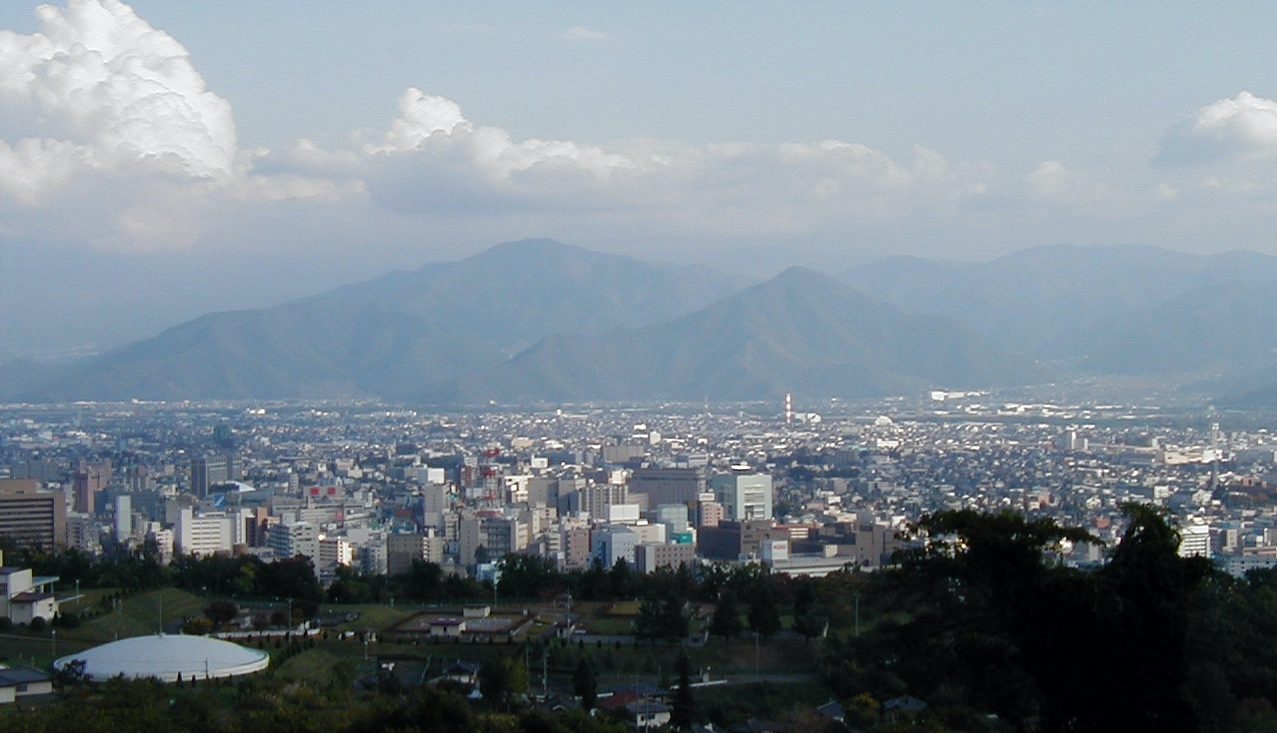
Header photo: View of Nagano and the hazy mountains, from the sakon inari (fox shrine) on the side of Asahi-yama.
The fun fact for River is that the cover image is a colourization of a photo I took of branches reflected in a murky pond. The pond at Zenkoji!
–Jamie Tennant