David Szalay, Flesh, McClelland & Stewart, 2025.
Reviewed by Karen Robertson.

David Szalay’s novel, Flesh, is a smooth, seductive, and understated account of István’s life, who we meet as a 15-year-old Hungarian boy living with his mother in a small-town apartment complex. His story unfolds through the relationships and events of his life, moving periodically through Hungary, to London in his early twenties, and later to Germany where his employment in private security brings him into the lives of his wealthy employers.
At 15, István is minimally accepted at school, occasionally helpful to a neighbour, and both sexually curious and disconnected from any ability to make a sexual advance. Passivity and expectation emerge around early events in his life and remain its primary drivers. Under their influence, the novel becomes both a compelling tale about an individual in specific circumstances and a complex exploration of agency — how much of our lives befall us and how much is dependent on our power to act?
Szalay exposes how little we can understand about our own actions and the potential futility of effort in light of that opacity. István is a mystery to himself. Although he shapes events, “Even so, his own actions are hard for him to understand.” At equally decisive moments, we learn that István feels that “It’s hard to say what his intention was when he did that,” and that “He has a strange feeling that something very significant has happened, only he isn’t sure what.”

At other moments in István’s life, we encounter him as blind to the circumstances that support and enable him. He muses on the possible success of an opportunity afforded to him by fortunate circumstances he did very little to shape, “There seems to be no limit to what is possible there. And whose achievement is that, he thinks, turning off the light and slipping quietly out of the room, if not his own?”
Despite this lack of insight, there is evidence of István’s personal growth throughout the novel, demonstrated both through István’s reflections and Szalay’s writing. The prose is stark as the novel begins but grows richer in its descriptions of the increasing complexities in István’s life and warmer as that life progresses. István develops insight into himself, for example, in the context of relationships with women, explicitly aware that for him, “…to be with any one person feels like an arbitrary thing, and that arbitrary feeling has started to undermine any lingering sense that there might be a particular person that he’s somehow meant to be with.” Szalay illustrates the increasing complexities in István’s life with observations, such as “…and they walk back towards the house and as they do that she does something that István has never seen her do before—she touches her husband in an affectionate way.” Later, the prose grows richer, for example, “…London shimmers in the distance. More immediately, the river takes the quiet autumn light…”

Szalay effectively employs the tension between István’s passivity and arrogance, on the one hand, and his developing inner life, as well as some difficult circumstances, on the other hand. Together, these create an opportunity to confront the expectations we hold about actions and their consequences, and perhaps even to recognize in our own passivity and expectations a weakness or failure that mirror István’s.
If there is a weaker aspect of the novel, it is a single plot point that risks being too convenient. That aside, the novel is a breezy, compelling, and engaging read that succeeds both in asking us to question ourselves and giving us the material with which to do so.

photo: Julia Papp
Now living in Vienna, David Szalay was born to a Canadian mother and Hungarian father, in Montreal in 1974, and moved soon after to Beirut and London, where he grew up. He went to Oxford University. He lived in Hungary for over ten years. He won the 2008 Betty Trask Prize for his first novel, London and the South-East (Johnathan Cape, 2008; Vintage, 2009), along with the Geoffrey Faber Memorial Prize. His novel, All That Man Is (M&S, 2018), won the 2016 Gordon Burn Prize, and for two stories from it, the 2016 Plimpton Prize for Fiction, awarded by the Paris Review. That novel was selected as a Book of the Year by the Guardian, Telegraph, New Statesman, TLS, Financial Times, the New York Times, The Paris Review, Harper’s Bazaar, NPR, and BBC Culture. His book of stories, Turbulence (M&S, 2019) garnered him the Edge Hill Short Story Prize in 2019.
Szalay’s sixth novel, Flesh, won the 2025 Booker Prize.
Further
- McClelland & Stewart imprint of Penguin Random House Canada. Penguin UK publishes his earlier novels.
- Paris Review Interview on being awarded the Plimpton Prize for Fiction (No. 217, Summer 2016).
- Szalay has written a number of radio dramas for the BBC.
- Booker prize interview on books that inspired Szalay, and an excerpt from Flesh.
- CBC interview on his Canadian connection, among other topics.
- The Guardian Books Interview, 22 February 2025.
- Betty Trask Prize


Karen Robertson is a public servant living in Ottawa. She competed a PhD in Philosophy at the University of Guelph and taught Philosophy at Trent University for six years. She is working on drafts of several short stories and exploring Ottawa’s nearby wilderness and fine restaurants.
photo: Karen Robertson;
photo by Lori Stratychuck
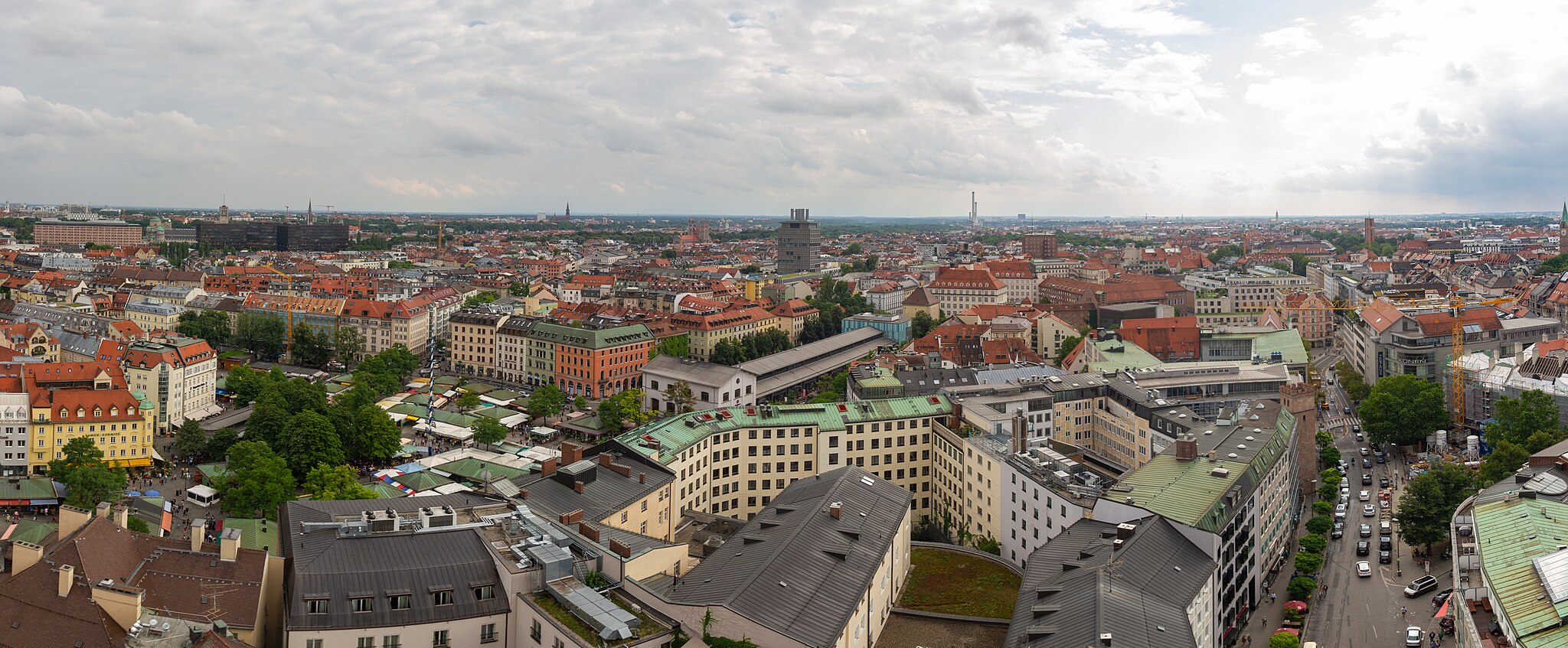
Header photo: View from St Peter’s Church, Munich: Maksym Kozlenko, CC BY-SA 4.0 via Wikimedia Commons.




One response to “Flesh”
Thanks for this review, Karen. I don’t know, but I wonder why this won the Booker Prize. It is a positive review, but it doesn’t sound like an important book. What is your view on its literary merit given that it won one of the most prestigious prizes in contemporary literature?
Thanks and best wishes,
Tim