

Review of The Finest Hotel in Kabul: A People’s History of Afghanistan,
by Lyse Doucet.
Penguin Random House UK, 2025.
Reviewed by Tim Martin.
It’s an intriguing title. Why would Lyse Doucet, chief international correspondent for the BBC, choose to write about a luxury hotel in Afghanistan? It’s an unusual entry point for the first major war of our century, in which the combined forces of NATO were defeated by semi-literate fundamentalist insurgents. Like its title, the book is intriguing and fresh. The Canadian connection here is that the author is Canada’s foremost international journalist.
Doucet knows what she is talking about. She first went to Afghanistan in the winter of 1988 to report on the Red Army retreat after “a disastrous decade long occupation.” She checks into the Hotel Inter-Continental Kabul (everybody called it the Inter-Con) the day after her 30th birthday. The hotel became her home for a year, and she returned many more times to “the world’s most sought-after dateline” to cover “the most grievous war in the world.” (When you put together the Soviet occupation, the Taliban war against the Mujahedeen and the NATO fight against the Taliban, you get four decades of war with civilian deaths approaching the million mark.)
Subtitled “A People’s History of Afghanistan,” the book tells us the story of this war as experienced through a set of Afghans who worked at the Inter-Con and whom she came to know through her many stays there.
We see the early days of the hotel, which opened in 1969, through the eyes of Hazrat. Tall, dark, handsome, and strong from his boxing workouts, Hazrat served as a bartender, waiter, and then was promoted to housekeeping. “This was a job you were proud to tell your family and friends about.” He received exacting training about what to do and what not to do, according to the highest international standards — including personal grooming. His dad had died when he was young and Hazrat needed a decent job to support his mom, three sisters and six brothers.
The Inter-Con fit into King Zahir Shah’s desire to bring Afghanistan into the modern world and entice the modern world into Afghanistan with lodgings suitable for a better class of tourists than those who arrived via the hippie trail to India, “high on drugs and low on cash.” Discos, miniskirts, and alcohol were part of the social change. The Inter-Con had women employees in every department. Hazrat and the others were dedicated to showing their guests the finest of hospitality in a country for which hospitality is a sacred duty.
Knowing what we do about Afghanistan, we get the sense that the Inter-Con’s luxury catering to rich expatriates and the Afghan upper class, combined with bikinis around the pool and female staff in western style uniforms, cannot end well. Indeed, there were violent reactions against the modernization of women’s roles in Afghanistan at this time. Religious zealots threw acid in women’s faces.
The constant suspense about what will happen to the hotel next makes this a page turner, and the author’s vivid prose conveys the fearful disorientation of being a citizen of a country falling apart. For example, there was a crackdown in 1973. Telephones went down, schools didn’t open, “tanks growled through the streets.” The radio crackled “on and off with martial music and nationalist anthems.” That was the coup that tipped Afghanistan into the Soviet orbit. Portraits of the king came down. Portraits of General Daoud went up. Hazrat kept mixing cocktails.
We come to care about the staff, as Doucet does. Each chapter of this tragic history is told from the point of view of a staff member. Amanullah is with room service when the Mujahedeen, with massive American support, start to gain ground and close in on Kabul. Their missiles strike right next to the Inter-Con. Mohamed is waiting tables when Gorbachev decides that it’s time to pull out. Mujahideen warlords take over the country, and a period of corrupt chaos ensues.
The hotel, no longer part of an international chain but still called the Inter-Con, keeps going, but only barely. Teenager Jamshid is bellhop in 1991 when the Taliban take over the hotel, rip out the music systems and throw every bottle of alcohol on the ground to be pulverized by a tank.
The fall of the Taliban government re-awakens hotel staff aspirations and there are opportunities for women again. In 2002, Abida starts work as a cook. She can’t read, but her silky Afghan dumplings are irresistible and are added to the menu. The job is a godsend for the poor widow.
We also feel the blood curdling terror of the 2018 attack on the hotel. A Taliban suicide squad assaulted the hotel with the intent of killing everyone. Mohamed and his colleagues rode out the attack hiding for their lives in a broom closet, while other staff and guests were killed in cold blood. Here is the 2020 fall of Kabul: “A wave of panic was crashing over the capital, beeping, shouting, shrieking.”
Doucet has a unique take on a story that is fast fading from our screens and memory, though it shouldn’t. Afghanistan was Canada’s longest war ever. The distant conflict in Afghanistan came to Canadians in a script largely written by generals and politicians. Combat and Canadian casualties dominated the news cycle and became rooted in our national consciousness. The Finest Hotel in Kabul brings a human dimension to the headlines of the Afghanistan crisis. Doucet’s major historical and literary contribution is the lived experience of her characters.
Her command of the facts and geopolitical context of the cycles of the Afghan war is assured and clear eyed, but her own role as a character is modest and restrained. I had hoped to hear what she would have to say about the hellish nihilism of the Taliban use of suicide bombers, including recruitment of children — something that I never could understand. She does not go there or editorialize about why everything went so wrong. Maybe it is journalistic dedication that keeps her firmly in the role of objective observer. Maybe she wants to put her characters first and foremost.
I was part of the NATO campaign as leader of Canada’s civilian reconstruction and humanitarian work for our last year in Kandahar (2010/11). Even though I lived and worked in Kandahar city, blast walls and the unforgiving operational tempo of an active war zone separated me from the human reality of the Afghans we were fighting to help. It was painfully difficult to meet and know Afghans. To do so would put them and their families at the risk of reprisal from the Taliban, who had eyes and ears everywhere.
It takes intrepid and resourceful journalists like Doucette to brave war zones and find the stories that we need to hear. She is joined in the book by a colourful cast of war correspondents. They needed phone lines and satellite feed more than working toilets and shared hardships and dangers with the hotel staff. It is heartwarming to see the happiness and camaraderie with which staff welcomed back veteran journalists to cover the next crisis. Tracing these friendly bonds lightens a story we know has a sad ending.
The gift of literature is emotional connection across time and space. Through this book, Doucet brings us the pride and hope that the Inter-Continental hotel gave to the Afghans who worked there.
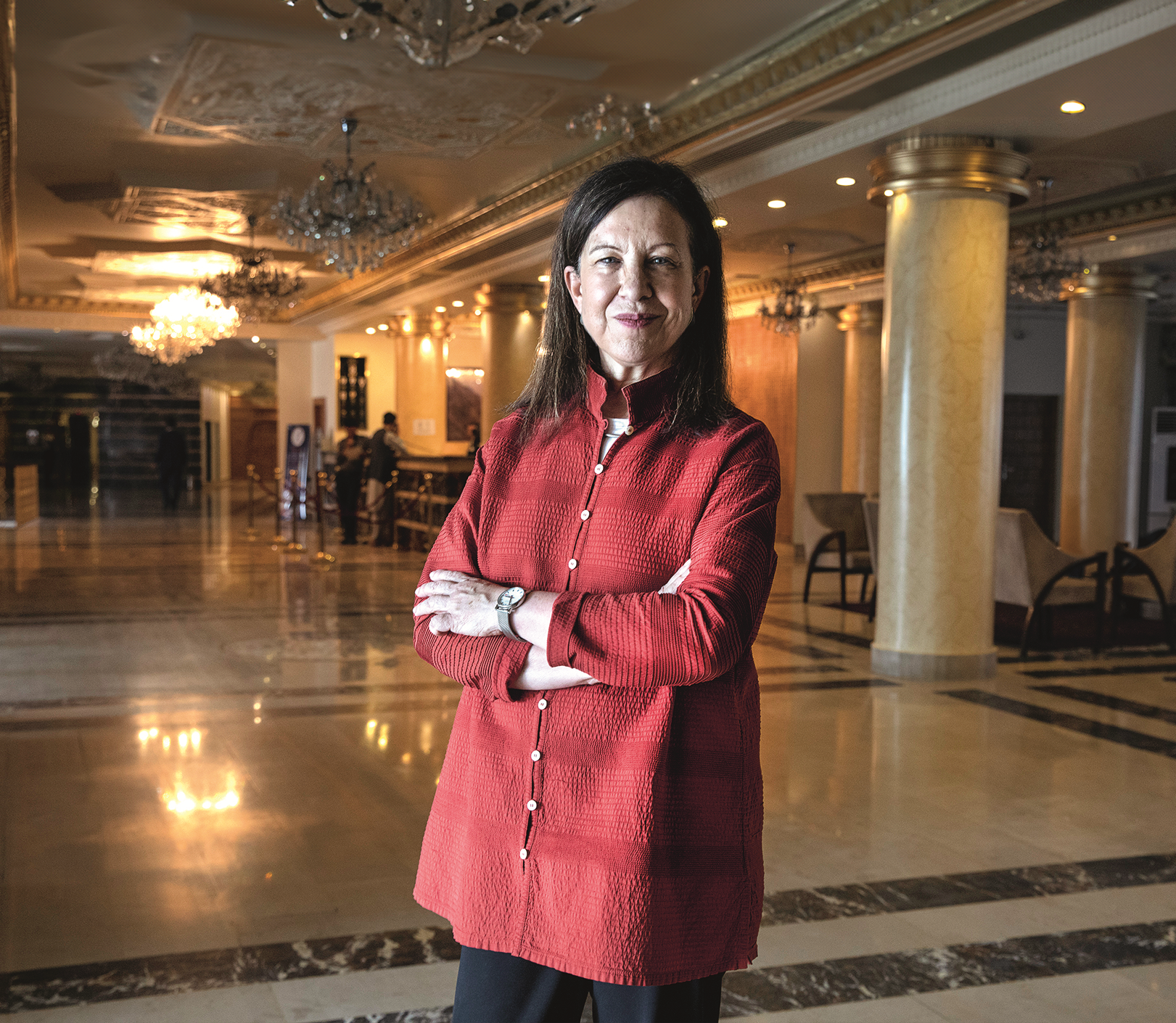
photo: Paula Bronstein
Lyse Doucet is a Canadian journalist and the BBC’s Chief International Correspondent, leading the BBC’s coverage of the recent Iran-Israel war, the US-led invasion of Afghanistan, the Arab Spring, and the Syrian Civil War. In the course of a career spanning four decades, she was based as a correspondent in Tehran, Jerusalem, Amman, Islamabad, Kabul, and Abidjan. She received an OBE in the Queen’s Honours list in 2014, and was admitted to the Order of Canada in 2019. In 2021, she was nominated for a Peabody for her work as a writer and reporter on the BBC podcast “Afghanistan: Documenting A Crucial Year.” Doucet has been reporting on Afghanistan since 1988. She visits the Inter-Continental whenever she is in Kabul.

photo: Kevin Carrel Footer
Former ambassador Tim Martin is the author of Moral Hazards, a political thriller that draws from his 30-year experience in international peace and security. Longlisted for the 2025 J.W. Dafoe Book Prize, his second book, Unwinnable Peace, tells the story of Canada’s war in Kandahar Afghanistan.
Further
- The Finest Hotel in Kabul long listed for the Women’s Prize for Non-fiction.
- Annemarie Hou in Conversation with Lyse Doucet, UN YouTube, February 2026.
- Lyse Doucet book launch interview with Janice Stein, Founding Director of the Munk School of Global Affairs & Public Policy, November 2025.
- “I am proud to be Canadian.” –Lyse Doucet, on receiving the Order of Canada, Governor General of Canada’s page, which locates her in Bathurst, New Brunswick, and London, UK.
- Doucet’s BBC reports from Kabul.
- Taran Khan, author of Shadow City: A Woman Walks Kabul, recommends books on Afghanistan, on Five Books.
- Canada in Afghanistan (2001-2014), DND.

One response to “The Finest Hotel in Kabul”
This is the k ind of journalism that we like. Keep it up.