
Review of Into the Breach: A Soldier’s Journey, by General Wayne Eyre.
Simon and Schuster Canada, 2026.
Reviewed by Tim Martin.
Every country has an army. Its own or somebody else’s.
-Eyre, Into the Breach, epigraph to Chapter 15.
If you care about Canada’s security, recent history and governance, this is an important book for you. General Wayne Eyre is our former Chief of the Defence Staff (CDS) and was the highest ranking person in the Canadian Military. Into the Breach describes Eyre’s life path from joining the Army Cadets at age 12 in small-town Saskatchewan to his commissioning with the Princess Patricia’s Canadian Light Infantry in 1988, and through his retirement in 2024 as a four-star general, the pinnacle of the profession.
Complex and extreme, war threatens the very existence and survival of states and peoples. How do we prepare for that? How do we find and shape men and women ready to lay down their lives for Canada? How do we try to guess who and what they will need to fight and then equip them for it? Eyre takes on these questions through the lens of his first-hand experience in barracks, battlefields, and halls of government power.
Trump’s calls for Canada to become the 51st state, plus other international threats, mean that we can’t take our national security for granted the way we used to. Our territorial integrity and sovereignty are more than political abstractions now. They are fundamental conditions for Canadian democracy and self-determination. Eyre argues that it’s urgent to adapt to this new reality, and Into the Breach is a good basis for better understanding what our military can do and what more we need.
The book will be of value to general readers looking for a good picture of the major events of Canada’s recent military history, such as the Canadian campaign in Afghanistan, how our armed forces are structured, and the web of international military relations within which Canada’s military operates. Of use to contemporary policy makers and analysts are the first-hand accounts from that tricky borderland between politics and the military institution.
Eyre’s 40-year career path took him through the major geopolitical crises of his time, and his detailed eyewitness reports on the operations in which he participated provide rich material for military and diplomatic historians. For example, Eyre was a platoon commander in the UN peacekeeping mission in Cyprus in 1989. This was a classic UN peacekeeping operation that started in 1964 and is ongoing today. It separated the parties to a dangerous conflict, but instead of finding a political solution, it froze the conflict. He conveys that at times that conflict could seem absurd, as when “Fueled with liquid courage a number of (Greek Cypriot) soldiers flashed their genitals to the Turkish Cypriot sentries on the other side (of the separation line).”
In 1993 Eyre was with a reconnaissance platoon on the Serb-Croat line of confrontation when the Croatian Army launched a surprise offensive against Serb held villages in the Medak Pocket. Canadian forces were deployed to enforce the ceasefire. The situation turned intense and dangerous fast. It was here that Eyre saw the horrors of ethnic cleansing, for example, “discovering the bodies of two young women, obviously held for several days, and subjected to untold horrors.” They were subsequently burnt beyond recognition as the Croatian forces withdrew.
The Balkans was where peacekeeping went to die. Outgunned by the ethnic hatreds released by the breakdown of order, peacekeepers did not have sufficient force or unity of purpose to confront the warring parties and deter them from war crimes. Between the warring parties, troops contributing countries and international organisations, managing the battle space was like a game of 3D Chess.
Other high points he describes are commanding the huge NATO mission to train Afghan security forces and serving as Deputy Commander of the UN Command in South Korea.
Eyre comes through as highly intelligent, ambitious, athletic, dedicated to both his family and military service. Eyre holds three master’s degrees and an honorary doctorate of military science. He presents as a serious military scholar, but with a quirky side. The epigraphs (each chapter has one) range from Viktor Frankl to Star Trek’s captain Jean-Luc Picard.
As his span of control increased, Eyre gained an expanded understanding of the role of the Canadian Armed Forces (CAF) in Canada. Fires, floods, arctic patrols, and G7 summit security are part of the package. COVID 19 was a special case. When it emerged that two thirds of deaths were in long-term care facilities for the elderly, the Premier of Quebec called for the CAF to come to the rescue. “Despite it being a far from appropriate military task, the federal government acquiesced and CAF went to work.” Eyre is clearly unhappy about military personnel serving as a patch for provincial underfunding of social services. Nor, he says, is it what members signed up for.
The book is dedicated to his wife, Jennifer, which is fitting and important considering that the support of military families to active-duty members is integral to the health and performance of the Canadian Armed Forces. Eyre consulted her before every major career decision he made. At the same time, more about how Eyre’s rise through the ranks affected Jennifer’s teaching career would have helped us better understand the sacrifices and contributions of today’s military families. Of course, I respect his decision to draw personal boundaries as he sees fit.
The Canadian military has an intimate connection with the U.S. military, and Canadian officers frequently serve in the U.S. military chain of command. Eyre was Deputy Commanding General – Operations for the XVIII Airborne Corps, a rapid deployment force, and deployed with the Corps to Afghanistan. He also completed the U.S. Army Special Forces Qualification Course to earn his Green Beret, in addition to other advanced military training in the U.S. The integration of the Canadian military with the U.S. military is deeper than most Canadians know; there is a broad network of close personal relationships at the top. Of course, the discrepancy in size and power is vast. The U.S. military is 35 times bigger than ours. Eyre extols the benefits of the relationship with many examples. But I wish he had said something about the risks of our dependence on the U.S. in light of Trump’s reckless international behaviour.
As a military leader, Eyre was often disappointed by government underfunding of the Canadian Armed Forces. Looking to the future, he fully endorses Canada’s plans to dramatically increase spending and provides advice on how to do so with a focus on resilience, better balance between domestic and international operations, as well as threat awareness that stretches from outer space to seabed to cyberspace.
Into the Breach is a significant and important book for Canadians. It is a service to our history and our democracy. I think memoirs by the top soldiers who protect our democracy should become a tradition and I hope our current Chief of the Defence Staff, General Jennie Carignan, writes one after she retires too.

General Wayne Eyre; photo: Private Michael Seelt,
Canadian Forces Support Group (Ottawa-Gatineau)
General Wayne Eyre retired in 2024 as Canada’s Chief of the Defence Staff. In that role, he led Canada’s military through a complex mix of international and domestic crises. During his decades of military service, he led numerous operations in Canada and deployed on missions to Cyprus, Croatia, Bosnia, Afghanistan, and South Korea. He was the most senior Canadian military officer ever permanently stationed in the Indo-Pacific region when he became the first non-American deputy commander of United Nations Command in South Korea. He also commanded the reconnaissance platoon in the Battle of Medak Pocket—Canada’s largest battle between the Korean and Afghanistan Wars—and the unit mentoring the Afghan National Army in Kandahar, Canada’s largest-ever combat advisory mission up to that point. Eyre is the recipient of numerous high-level Canadian and foreign decorations. Since retirement, he has been writing, teaching, speaking, and advising.
Former ambassador Tim Martin is the author of Moral Hazards, a political thriller that draws from his 30-year experience in international peace and security. Longlisted for the 2025 J.W. Dafoe Book Prize, his second book, Unwinnable Peace, tells the story of Canada’s war in Kandahar Afghanistan.
Tim Martin; photo: Kevin Carrel Footer

Further
- Battle of Medak Pocket.
- Princess Patricia’s Canadian Light Infantry.
- Women in the Canadian Armed Forces.
- Simon & Schuster Eyre events.
- Remembrance Day (DND) and Veterans’ Affairs Remembrance Day.
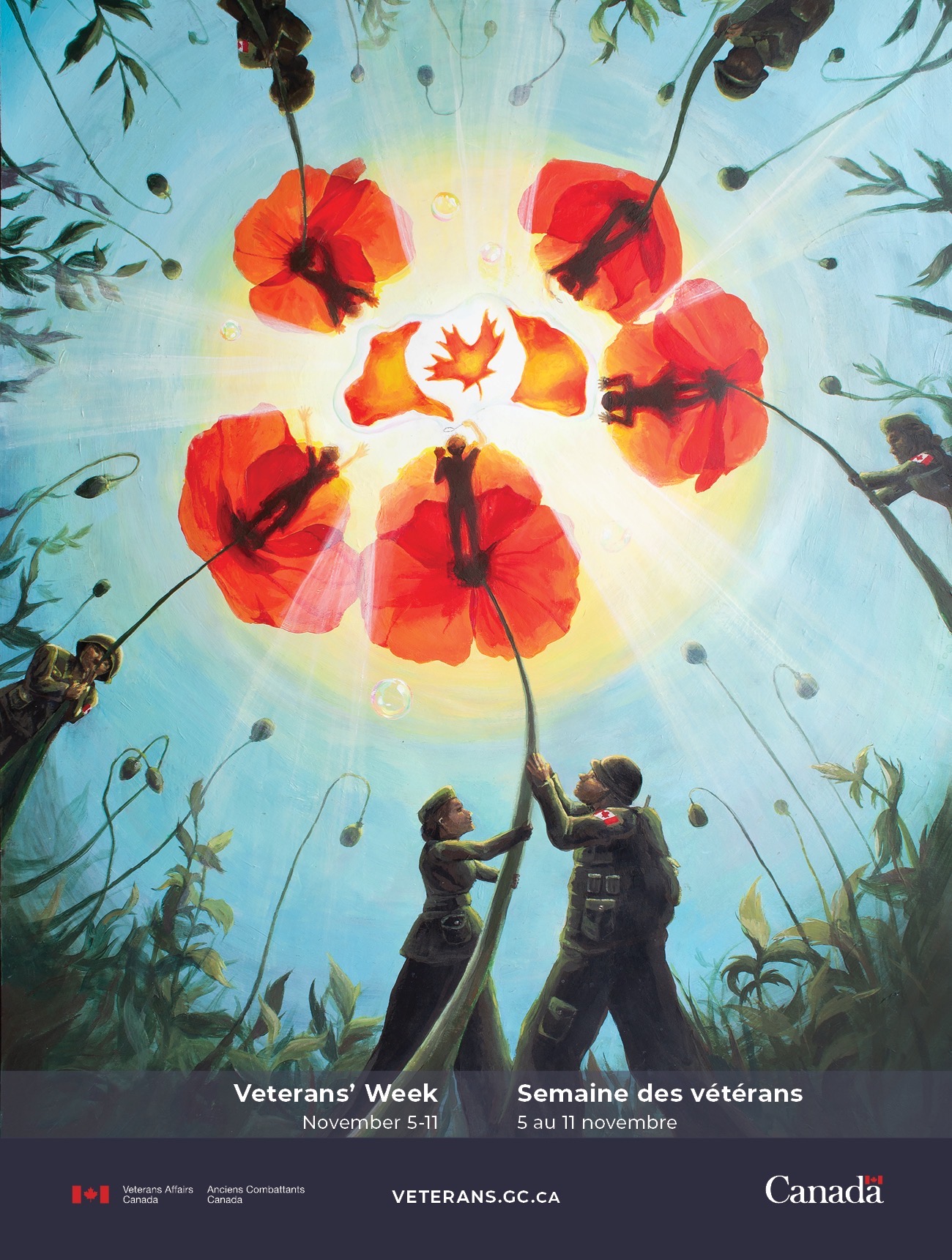
Header photo from Veterans’ Week poster by Chaelyn Han, Veterans’ Affairs.


Leave a Reply