
Anne Hawk, The Pages of the Sea (Biblioasis, 2024).
Review by Debra Martens
In 1948, the ship the Windrush brought the first migrants from the Caribbean to the UK, following the British Nationality Act that gave British subjects of the colonies the right to live in Britain (for postwar rebuilding). They and the emigrants who came until 1971 are now referred to as the Windrush Generation. Various changes to the Immigration Act over the years changed their ability to come and go, and eventually changed even their citizenship status. In 2018 there was a scandal because people who’d come from the colonies, some as children, were being deported for lack of paperwork. While many have written about what it was like to settle in the UK, such as George Lammy, Andrea Levy, and Samuel Selvon, not many have looked at the children who were left behind when their parents emigrated. Anne Hawk’s first novel, The Pages of the Sea, addresses that lack.
The protagonist of The Pages of the Sea is Wheeler, the youngest of three sisters whose mother leaves them in the care of their two aunts and various cousins when she takes a boat to England to work. Wheeler misses her mother, and her thoughts often return to the mother she loves. Her older sisters are annoyed by her repeatedly asking when their mother will send for them.
When not in school, Wheeler hangs out with her cousin Donelle, whose older brothers are Jonaton and, by a different father, Floyd. Floyd is abusive, and unchecked by his ill mother, Tant Innez. But Donelle is a boy (or bwoy), a child with less power than Wheeler has, and is no substitute for a mother. Nor are her older sisters, whose attention to her switches between impatience and scolding. Their indifference arises partly from their own need to survive the situation in which they find themselves. All of which aggravates Wheeler’s sense of injustice.
The woman who is kind to them, the woman who should stick up for them, their mother’s sister Celeste, is herself being bullied by Floyd and therefore by her sister, Floyd’s mother. Wheeler gradually comes to understand the conflict between the three of them, but it doesn’t make the hurt any less when Celeste fails to protect her.
And so Wheeler learns to take care of herself, acting on a decision that could separate her from her mother, should she ever return or send for them.
Hawk’s novel is rich in detail. Wheeler’s older sisters walk her to and from school, and we see this: “Flotillas of schoolchildren bustled along Russell Street, white school shirts bobbing in the sun” — imagery that picks up on the nearby harbour, the island geography. “Long lazy slopes fell down to the shore…” Wheeler and Donelle’s outings involve descriptions of the landscape, from its volcanic rock, its steep climb of the Cut, to its frightening banana groves that could be hiding a jumbie or ligaroo. Hawk treats us to the ingredients in staple dishes, to the routines of weekends, to the anticipation of holidays and festivals.
Perhaps most importantly, she gently initiates the reader into Caribbean English. I will confess that this book is not easy to read, but if you are comfortable reading James Joyce and William Faulkner, you will have no problem adapting to the switches between the Standard English of the narrator to the Caribbean English of Wheeler’s thoughts and speech. For example, we begin with easy vocabulary, such as “dem” and “warnt” (them and want, by context). Then a question from Celeste has Wheeler worrying: “She di’ still getting used t’she ant. She dint know how she goan act sometimes.” You can figure it out. As you can: “She mudda di’ go in England on d’banana boat.” It makes for slow reading, but by novel’s end, you feel the full impact of longer passages, such as her sister Hesta’s remark, “Some people dey go in Ingland, dey in never sen f’dey big chil’ren. All o’we hav t’go together.”
As for the criticism that the use of dialect is not recommended in contemporary fiction, I repeat that most of the story is told by a narrator.
The Pages of the Sea is important not only as an addition to the stories of the Windrush Generation but as a bildungsroman in its own right.

photo: Panagiotis Ziakas
Anne Hawk was born in Grenada, spent a good part of her childhood and early adulthood in Vancouver, and has Canadian citizenship. She has worked as a journalist, a paralegal, and a secondary school teacher. Married, she currently lives in London, England, and identifies as Grenadian, Canadian, and British.
Hawk’s debut novel, The Pages of the Sea, was a Globe 100 Best Book of 2024, a Guardian Best Fiction Book of 2024, and a CBC Best Fiction Book of the Year.
Further
- OpenBook interview, November 1, 2024.
- Claire Adam’s review of The Pages of the Sea, The Guardian, July 25, 2024.
- Kerry Clare in conversation with Anne Hawk.
- Anne Hawk on Caribbean English, Biblioasis.
- Biblioasis (to order book).
- BBC on Windrush Generation.
- Exhibition on Windrush Women.
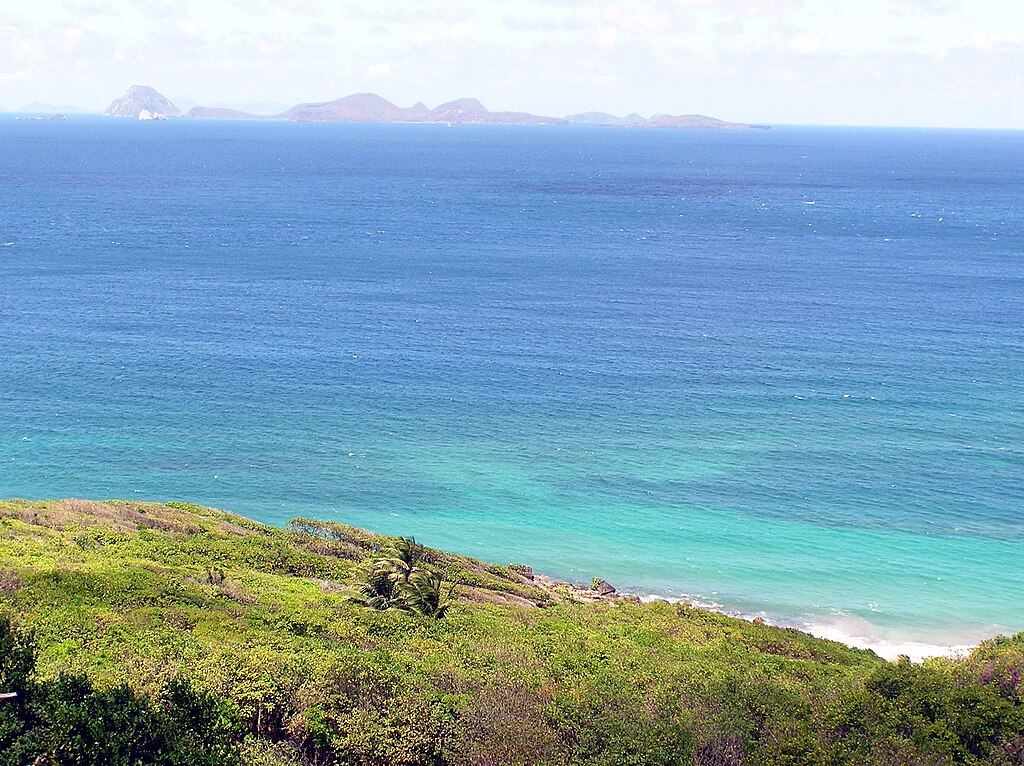
Header photo of Grenada: Wikimedia Commons: Stefan_und_Bille, CC BY-SA 3.0 https://creativecommons.org/licenses/by-sa/3.0.


Leave a Reply